Independent analytical practice · Beirut
Not what the statement says. What it asks you to accept.
An analytical practice reading Lebanese politics, Levant and Gulf geopolitics, and the strategic communications that frame them, from primary sources, in three languages of record.
Languages of record
English · Arabic · French
Output
Open publication · Commissioned research
First contact
Chatham House · reply in three working days
Contracting
US-registered LLC · Stripe or wire
§ 01The lead
The lead piece · MAR 2026
Three governments, one story.
How Riyadh, Tehran and Beirut framed the same week, side by side.
The week of February 17–23 produced something unusual in the regional record. A careful reader will note immediately that the three statements do not agree on what the event was. These three frames are not compatible. One closes it. One extends it. One declines to enter it at all.
§ 02State of play
built · open
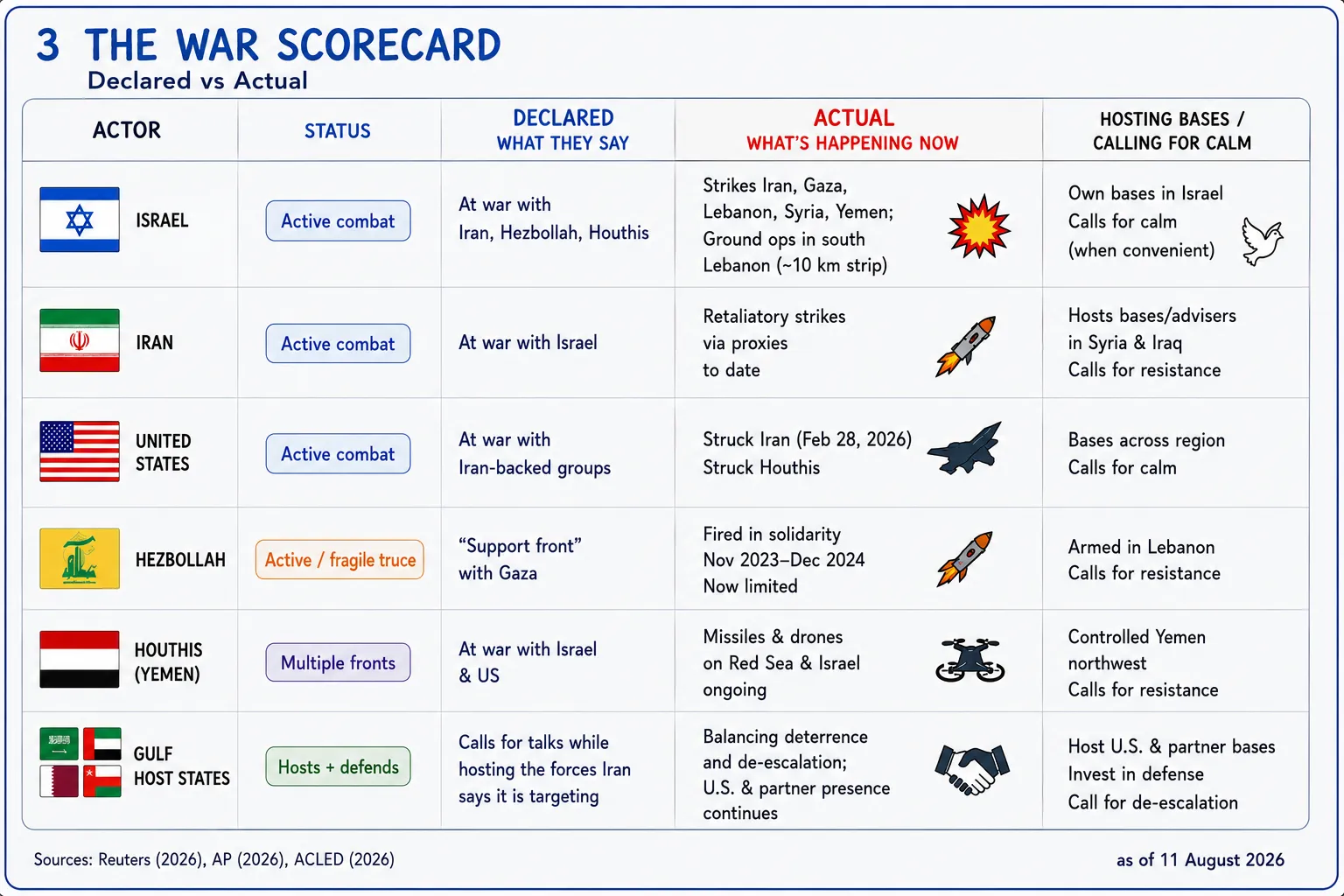
The War Scorecard
Who won the 2026 war? What six actors say, against what they are doing.
Six actors, what each one says, what each one is doing, and where the fighting or the bases actually are, read side by side, with three chains of contradiction the official language is built to hide.
Actors
Six
As of
11 Aug 2026
Every fact in the plate below also lives as text inside the file.
§ 03Also in the archive
- The Lebanese pound, twelve months of central bank communications A monthly tracker of vocabulary, frame, and what was not said.
- Saudi state messaging after the October pivot A quarterly report on a strategic shift in Riyadh's narrative posture.
- The judiciary file, Q1 2026 What changed, what nobody is saying about it, and what the silence implies.
§ 04Coverage
Beirut is the reading desk.
Eleven primary-source capitals, followed continuously across the Levant and the Gulf, read in the language they were issued in.
§ 05The method
Collect
Circulars, gazettes, parliamentary records, MP statements, embassy releases, read in the language of record.
Parse for architecture
What the source claims, what it omits, and which vocabulary it instructs the reader to use.
Synthesise
What reading the source structures in the reader’s mind, with the primary documents attached.
Read the source for what it asks the reader to believe, not for what it says. The architecture of a statement carries more information than its content.
Editor's note · Beirut Desk, March 2026
§ 06Commission work
Commission work.
Eight ways to engage the desk, from a 48-hour crisis read to a six-month narrative retainer. Scoping conversations carry no obligation.