built · open
Libya, Year Twelve of the Transition
How the oil money flows while the state is split.
As of
11 Aug 2026
Actors
Four
Since
10 Apr 2026
Sources
International Monetary Fund · Reuters
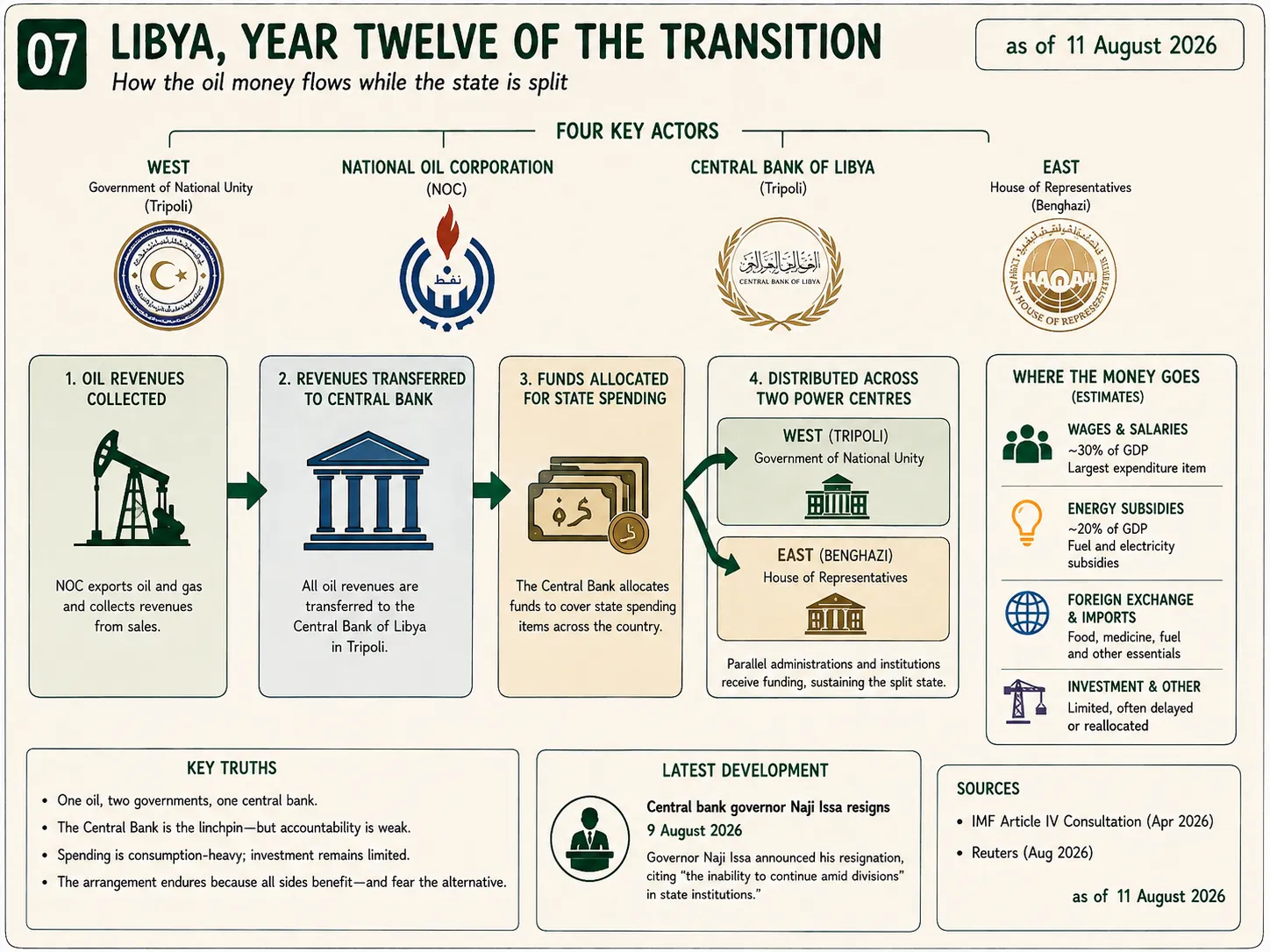
The state is split between two power centres, but the money is not. Oil revenue runs through one national oil company into one central bank, and both governments depend on the same stream. The division is political; the plumbing is shared. That is what makes the central bank the pressure point.
§Where the money goes
| Destination | Share or note | Source | Constraint |
|---|---|---|---|
| Wages IMF | Wage bill around 30% of GDP. | The largest single call on the revenue stream. | Nationwide. |
| Energy subsidies IMF | Around 20% of GDP. | A second structural claim on the same revenue. | Nationwide. |
| FX / imports Allocated | The central bank allocates scarce foreign currency. | Rationing, not spending. | Through the central bank. |
| Investment Weak | Needed, but governance and oversight remain weak. | What is left after the three above. | Nationwide. |
How the oil money flows
One revenue stream, one central bank, two power centres that both need it.
-
01 NOC
documentedSells oil and receives hydrocarbon revenue.
-
02 Central bank
documentedReceives foreign exchange, allocates liquidity, manages the exchange rate.
-
03 State spending
documentedSalaries, subsidies, imports and operating expenses.
-
04 Two power centres
documentedTripoli and the east both need the same national money system.
How the steps depend on each other
- L1 L2 Hydrocarbon revenue enters the central bank as foreign exchange.
- L2 L3 The central bank allocates liquidity to state spending.
- L3 L4 Both power centres draw on the same spending system.
What is not settled
Chains of contradiction
-
A divided state with undivided plumbing
- Two governments claim authority over Libya.
- One national oil company sells the oil.
- One central bank receives the foreign exchange.
- Both power centres depend on the same national money system they cannot jointly govern.
-
The pressure point is an office, not a front line
- The central bank allocates liquidity and manages the exchange rate.
- Wages are around 30 percent of GDP and energy subsidies around 20 percent.
- Whoever holds the bank sets what everyone else can spend.
- The governor resigned on 9 August 2026.
Changelog
- 11 Aug 2026 File created from the commissioned plate.
Sources
- P7-S1 International Monetary Fund Article IV mission: fiscal deficits, oil windfall, wage bill, energy subsidies and the central bank's role 10 Apr 2026 official international institution link pending verification
What this source establishes
- Revenue flow
- Wage bill around 30% of GDP
- Energy subsidies around 20% of GDP
- Central bank role
- Two power centres
- P7-S2 Reuters Central Bank governor resignation and renewed political pressure over oil money 11 Aug 2026 wire service link pending verification
What this source establishes
- Governor Naji Issa resignation, 9 August 2026
- Documents confirmed
- Political pressure over oil money
Data range: April to 11 August 2026.